Thursday, 28 May 2015

Join the Set Her Free demo at Yarls Wood on 6 June

Next weekend I’m going on my first demo for nearly three years. It’s taking place at Yarls Wood – the detention centre where women refugees are indefinitely incarcerated after arriving in the UK seeking asylum. 

Our demo’s demand? SET HER FREE! 

If you live in Bristol, join the coach to Yarls Wood by signing up here

If you live anywhere else, here’s the link to the demo.  

I first became aware of Yarls Wood when I attended a talk by Women for Refugee Women and their sister organisation Women Asylum Seekers Together

I listened to women talk about the abuses they had faced in their country. They described fleeing and arriving at the UKBA. Women talked about being faced by male officials who asked them to talk about the violence committed against them. They explained how they felt uncomfortable talking about rape to male officers, and how no one told them they could speak to a woman. They said how the officials didn’t believe them. They told us how they were put on the ‘fast track’ system and how most fast-tracked applications fail and then need to be appealed. They told us how they were locked up. 

As I listened in horror, one woman said:

The physical scars from the violence I suffered in my country will heal. The emotional scars from what happened here will stay with me forever.”

Another woman spoke:

I didn’t come here for a better life. I had a good life. I came here not to die.”

(I’m paraphrasing from memory)

Hearing those words, I felt real shame at the way our country treats some of the world’s most vulnerable women. I felt ashamed that these women came to our country to survive, and we responded by locking them up in a de facto prison. 

A report published last year by Women for Refugee Women laid out bare the reality of incarceration in Yarls Wood. It exposed how rape survivors were guarded by men – forced to go to the toilet or get undressed in front of male guards, and how 70% of the women surveyed said how having male guards made them feel uncomfortable. 

It revealed the high rates of depression and mental ill health, and how 22% of the women interviewed had attempted suicide in detention, with a higher number (61%) saying they felt suicidal. It gave a voice to women making allegations of ill treatment and sexual assault – 50% of the women surveyed talked about verbal abuse from staff, 22% disclosed racist abuse, 3 women reported physical assault and 1 women alleged sexual assault. And the report explained the mental toll taken on women who are locked up for no crime, and given no indication of when they will be freed, of if they will be deported. 

Since the publication of the report, the Government announced that it would investigate the allegations of sexual assault made against SERCO staff. And yet, the centre remains open. 

Last week I attended a talk by writer and activist Caroline Criado-Perez, who discusses the treatment of women in Yarls Wood in her book, Do it Like A Woman and Change the World.  She talked about how the well-meaning documents on refugee rights written in the wake of the Second World War were ‘male default’ guidelines that excluded the reasons why women might need to seek asylum. The failure to update these documents to recognise that women face persecution because they are women means that women refugees face different challenges to men. According to international policies on refugee rights, people can claim asylum based on, for example, political, ethnic and religious persecution. But gender-based persecution – such as domestic abuse, forced marriage, FGM and rape – is not covered. 

In short, refugee policy is written for men. 

This needs to be changed. We know that women face gender-based persecution across the world. We know that across the world women are enduring rape, domestic abuse, forced marriage and FGM. We need to have a policy that recognises these violations as happening to women and girls because they are women and girls. And we need to have a policy that means women and girls fleeing gender-based persecution can be given asylum. 

Until then our asylum system is failing women and girls. And so long as we persist in indefinitely detaining refugees in centres like Yarls Wood, we are failing as a country to protect and support some of the world’s most vulnerable people. 

Yarls Wood is a blot on our national conscious. 

It is time to shut it down and for the women held in detention to be set free. These women are not criminals. They have committed no crime. They have travelled to the UK fleeing rape, domestic abuse, FGM, political imprisonment, forced marriage, domestic violence, homophobic hate crime, rape as a weapon of war – almost unimaginable horrors. They have travelled here because to stay in their own countries is to endure more violence, more imprisonment, more war. They travel here seeking asylum. A safe place. Maybe even some kindness. 

And rather than offer them that kindness, we lock them up and don’t even bother to tell them how long for. 

This has to end now. 


Wednesday, 6 May 2015

The What the Frock Book of Funny Women is hitting the shelves

Great news!

Bristol-based comedy night What the Frock brings together the funniest women from across the UK, proving once and for all that the sexist stereotype that 'women aren't funny' is nothing more than a lot of misogynistic bilge.

Now they're going even further, with the publication of their Book of Funny Women.

The book is written by What the Frock founder, Jane Duffus and the foreword is by Lucy Porter. It profiles some of history's funniest women, and has guest contributions from everyone from Viv Groskop to Ian Martin.

I've recreated the press release below with all the details.

Happy - and hilarious - reading and well done to everyone involved in What the Frock and the fantastic work they do for women's representation.

The What The Frock! Book of Funny Women is published this May
to celebrate 100+ years of fantastically funny women


WHAT THE FROCK! COMEDY and BCF BOOKS announce the publication of the groundbreaking, myth busting paperback The What The Frock! Book of Funny Women (written by Jane Duffus, foreword by Lucy Porter) – which is putting an end, once and for all, to the tired idea that women aren’t funny by providing countless examples of side-splittingly hilarious women.

The book’s publication coincides with the third birthday of What The Frock! Comedy – the phenomenally popular, award-winning all-female comedy event that celebrates up and coming talent via stand-up shows, improv, workshops, an all-female comedy award and more.

The What The Frock! Book of Funny Women is a book of two halves. The first half contains chapters outlining the history and important role of women in comedy on both sides of the Atlantic, as well as addressing the myriad of obstacles that stand in the way of female comedians’ success. The second half of the book collects together more than 70 profiles of some of those women (from Caroline Aherne to Victoria Wood), and includes guest contributions from names such as Ian Martin (writer on The Thick Of It, Veep), Viv Groskop (comedian, broadcaster, journalist), James Mullinger (comedian, GQ comedy editor) and Kate Smurthwaite (comedian, broadcaster).

What The Frock! Comedy founder, and author of the book, Jane Duffus, says: “This book neither asks nor answers the question ‘are women funny?’ because of course women are funny. To suggest otherwise is as absurd as asking whether a man can be a nurse. This book presumes you know women are funny and confirms this by celebrating some of the wonderful women who have made us laugh for the past century or more. We shouldn’t have to segregate the genders in the 21st Century. But to me the important point is to provide a platform to nurture new female talent, and to continue to raise the profile of those talented performers in the media. This is what What The Frock! aims to do and this book is an extension of that goal.”

Comedian Jenny Éclair says: “A wise and witty guide to the wisest and wittiest women in comedy. At last someone gets it – women have funny bones! Read all about it.”


Visit the website at www.whatthefrockcomedy.co.uk

Find What The Frock! Comedy on Twitter (@WTFrock_Comedy)
and Facebook (facebook.com/WhatTheFrockComedy)

The What The Frock! Book of Funny Women by Jane Duffus
BCF Books, ISBN 978-0-9571275-0-0, £7.99, Published 11 May 2015

Monday, 4 May 2015

She's not like other girls...

I’m not like other girls! You can’t straighten my curls


No, sadly this post is NOT about PJ Harvey, I just can’t get that song out of my head because of the title of this post. 

It’s about BABIES!!


(Jarvis! Such moves!)

It’s about BABIES and EQUALITY! 

Yes, that’s right - unless you have been living under a rock for the last two days you’ll know by now we have a NEW PRINCESS! They even lit up Tower Bridge pink because girls are pink amirite it’s innate don’t you know, it’s not like gender is a construct and rigidly policed by societal expectations from the moment of the 20 week scan…But anyway, just as this post isn’t about PJ Harvey or Pulp or Jarvis Cocker’s dancing skills, it’s also not about gender stereotypes. 

It’s about this one sentence in Allison Pearson’s frankly nauseating front page Telegraph article published today called:


I mean, that headline tells you all you need to know about the squishy, sickly, syrupy prose. But the line in the article that caught my eye was:

One day, they will have to explain to their daughter that she is not quite like other little girls

She is not quite like other little girls. 

There you have it. One sentence that explains the utter absurdity of having a monarchy and a system of inherited privilege in 2015. 

It’s a system that enshrines inequality from day one. At some point, Pearson remarks, William and Kate will have to explain to Baby Girl that she is not like other girls. Not because she is special and unique and her own marvellous little person - as all girls and boys are. But because she was born into a family that has inherited wealth and privilege that most boys and girls born today could never imagine. And they haven’t inherited that wealth and privilege for any other reason than at some point in history their ancestors won a battle and decided winning the battle gave them a divine right to rule, and when we challenged that assumption we then gave them that right - and all the glitz and wealth that went with it - back, and have failed to challenge it since. 

Ca ira…

How can we ever hope for an equal and truly meritocratic society when we continue to insist that one family is apart from us? That one baby born on 2 May 2015 will not be ‘like other girls’ simply because of the family she was born in to? 

As a socialist, as a feminist, damn it as a human being - I cannot agree to a system that says this one baby is different to every other baby born on Saturday, and to every other baby born before and since. I cannot agree to a system that says one child will be born to wealth and privilege, whilst other children are born in poverty. I cannot agree with Allison Pearson as she cosily coos that this baby is “not like other girls” - not, again, because all of us are unique but because she was born to inherit power and wealth and we were born to…not. 

I believe that we must and should all be born equal with equality of opportunity to live out our true potential. I believe that every baby born in this country and around the world has the right to grow and learn and develop that potential. I do not believe that this Baby Girl is any more or any less special, any more or any less deserving, than all the other baby girls simply because of who her parents are. 

To me, the monarchy continues to be a great con. To paraphrase Marx, it’s offered to us as an opiate for the masses. I can’t help see the irony of this great celebration of inequality coming at the end of a government that has seen the yawning gap between rich and poor widen and widen until food bank usage has risen dramatically whilst the Times Rich List is the healthiest it’s looked in years. As we cheer and wave our flags in appreciation of the new baby, Cameron uses the rhetoric of scroungers and shirkers vs hardworking families as a justification to cut life-supporting benefits from the poorest and most vulnerable in society. As parents of disabled children are forced out of their homes because of the bedroom tax, we all quietly ignore the Royals requesting a hardship fund. As we’re told that people should work for free or lose their benefits, we all look away as William and Kate spend £4 million on refurbishing their palace that we pay for. 

It’s not fair. It’s not right. We cannot end inequality and have a monarchy. We cannot pretend we want equality when we place one family above anyone else for no reason other than history. 

And then of course, what about the baby herself? Does she want to be different to all the other little girls? William and Kate are (rightly) praised for their determination to keep their children away from the media glare. But when she’s 18 and not under their protection anymore, how long will it be before sneering articles come out mocking her body? Is that a future we want for any little girl - to grow up knowing that everything she wears will be mocked, that her body will be held up for scrutiny and found wanting? Perhaps the media should have actually read Mantel’s essay on Royal Bodies and learnt something from it, instead of calling her ‘ugly’. No one deserves the bile and hate that is poured on to royal women’s bodies. Why should she have to grow up under that spotlight? Why does she not get a choice either? 

Having a monarchy means we can never have a truly equal society. Having a system where one family have more, enjoy more and are told they deserve more merely because they are born into that family means our society will never be equal. How can we look at the babies born this weekend and tell them they can be anything they want to be, when at the same time we tell one baby that she’s not like other girls? How can we justify that inequality, that legally-enshrined unfairness, to all the children born this weekend? 

I wish William and Kate and the new baby well. But I also wish that this farce would come to an end. We are so far from having a true meritocracy where everyone is truly equal. And we won’t get any closer to that truly equal society so long as we have a monarchy. 

Why don’t we want equality for every baby born? Why are we happy to accept, in syrupy cooing prose, that one baby will always be different from us? Why we are we happy to accept that inequality for our own children? 

I’m not. 


Wednesday, 29 April 2015

When do women stop being people?

When do women stop being people? 

Actually, there are lots of times. When we’re treated like objects to be remarked upon on the street. When we’re treated like objects to be assaulted on the streets. When our utterly personal right to bodily autonomy is violated and stolen from us by abusers and rapists. When we’re reminded once again that men are default human, and we’re a vague category of ‘other’.

However, in this one particular post I want to talk about one particular moment when women stop being seen as their own person – pregnancy. 

On Monday night, I chaired a panel debate between the parliamentary candidates standing in a nearby constituency. The penultimate question was about abortion rights – specifically asking the incumbent MP why he had voted in favour of reducing the abortion upper time limit to 22 weeks and whether it was paternalistic for male MPs to decide on women’s bodily autonomy in this way. 

The MP and a couple of the other candidates answered gamely. It’s a question of viability, some explained. It’s a question on whether it is viable for the foetus to survive. It’s a question of whether medical advances have come so far that the foetus is viable. 

He, and others, didn’t mention the woman. 

It is remarkable, really, how quickly she is forgotten in a debate about her own body. 

It didn’t seem to occur to those arguing about foetal viability that a woman is involved in the pregnancy, that it is her body that carries the foetus and that it is her right to bestow personhood on the foetus growing inside her, not theirs. It didn’t seem to occur to them that perhaps she, rather than the state, might have a stake in her own body and its future. 

As I listened to the pro choice and the anti choice candidates express their views on foetus viability, I couldn’t help but feel that what we were actually debating was when women stop being people. We were arguing about the moment when a woman stops being a person and instead becomes a vessel that carries a potentially viable foetus. According to the pro choice MP, it was at 22 weeks of pregnancy. According to the anti-choice candidate, it’s day one of pregnancy. 

According to me, that moment is up to the woman. It is a woman’s choice whether the foetus growing inside her has personhood or not. 

Before I go any further we need to get some stats straight. Firstly, 90% of abortions are carried out before a pregnancy reaches 13 weeks. Secondly, 98% of abortions are performed before 20 weeks. Most late abortions are carried out because of a medical emergency. 

Of course, chances are if our laws included abortion on demand and women were not required to gain permission from two doctors before they’re allowed the operation, then even more abortions would happen even earlier. 

I wanted to turn to those men debating my humanity on the panel and ask them why they hadn’t considered the woman in their arguments on foetal viability. I wanted to ask them why they had taken the woman out of the equation. I wanted to ask them if they could imagine for a moment how it would feel to be forced to continue with an unwanted pregnancy against their will, or a pregnancy that could lead to desperate health complications or death. I wanted to ask them why they don’t believe it is up to the individual women to decide if the foetus inside her has a humanity that is equal to her own. I wanted to ask them why they believed its potential trumps a woman’s right to bodily autonomy. 

Abortion has been legal – with caveats – in England, Scotland and Wales since 1967. It remains illegal in Northern Ireland. Every year, thousands of women travel across the Irish Sea in search of an abortion. Why is their humanity not respected? Why is their right to bodily autonomy – a right that men here and in Northern Ireland take for granted every day – not enshrined in law? 

On the same day I chaired the debate, the Mirror ran a poll on whether it should be illegal for women to drink during pregnancy. 71% of poll respondents voted yes. 

Once again, we have to ask the question about whether we see women as people. I personally don’t think it’s a great idea for women to drink to excess during pregnancy – no one does. Of course that can lead to health complications in the child. 

But making it illegal? What does that solve? How does criminalising women support expectant mothers who may, for example have addiction issues? How can they access help if they are afraid that to do so would mean they risk arrest? What impact would criminalising women’s drinking have on an expectant mother’s confidence about going to see her doctor or midwife? What does it say about our view of women as people? 

And where do these kinds of conversations lead? These conversations about whether women are people or vessels? These conversations about whether women have a right to bodily autonomy at every moment of their life, or whether they should give up that right during pregnancy (and, as mentioned at the start, on other occasions too)? 

In the USA, these conversations have led to the arrests and convictions of women for foeticide. 

Last month, Indiana sentenced Purvi Patel to 20 years in jail for foeticide. Patel had had a miscarriage at around 23 weeks of pregnancy and – scared that her conservative family would discover she had had sex outside of marriage – threw the stillborn foetus away. It’s a tragic story. But her sentence is, fundamentally, punishment for a miscarriage. 

Patel is the first women to be sentenced under foeticide laws but she is not the first woman to be charged. In 2011 Bei Bei Shuai had a miscarriage after attempting suicide. She was held in prison for a year before charges were dropped as part of a plea deal. 

These are grim, grim cases. And they are part of the slippery slope that we slide down when we stop seeing women as people. With these two cases, the USA appears to be getting closer and closer to criminalising miscarriage. The Handmaid’s Tale was meant to be fiction – a dystopic sci-fi novel. It was not supposed to be America’s view on women’s bodily autonomy in 2015. 

None of these issues are easy. But I believe that when talking about pregnancy and abortion, we have to start from a position of women being people. We have to start from a position of women having a right to bodily autonomy. 

When we don’t do this, we have women dying from illegal abortions all over the world. We have women like Savita Halappanaver dying in hospitals because they’re denied the medical care they desperately need for their own survival. We have women too scared to seek support for addiction. We have women too scared to go to the doctors with a miscarriage. 

And we have a society that continues to refuse to allow that women might be people after all. 

That’s not good enough. 

So please, let’s start talking about women when we talk about abortion. 

Our bodies. Our rights. Our humanity. 

To support women in Northern Ireland seeking abortions, check out the Abortion Supper Network.


Friday, 10 April 2015

RESIST! A response to another victim blaming poster campaign

UPDATE! Sussex Police has announced they will be withdrawing this campaign

Still worth reading the post though, coz, you know, I wrote it! 


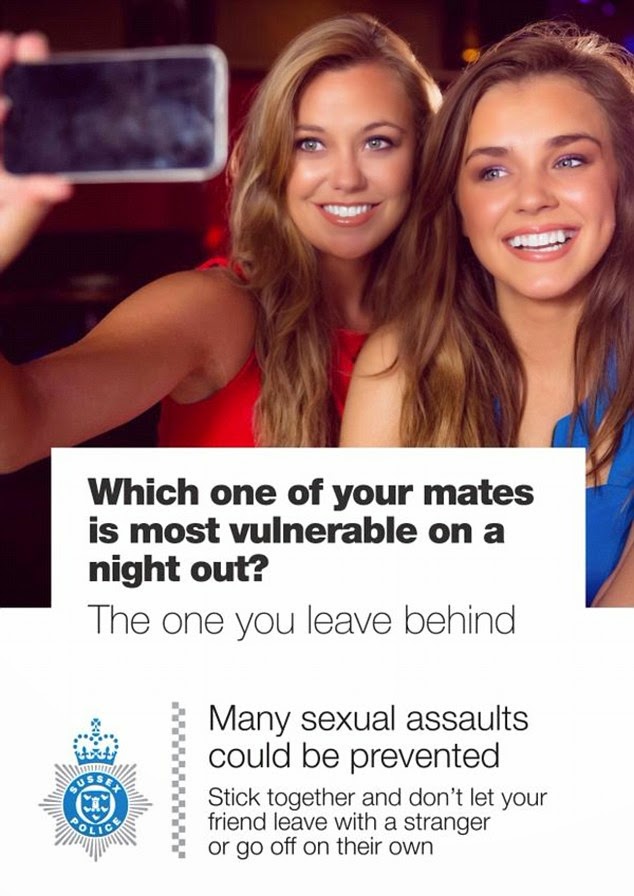
Slow handclap to Sussex police whose latest safety campaign falls back on the nice and easy trope of telling women that it’s up to us to prevent sexual assault. 


Yes that’s right ladies! Don’t expect rapists to take responsibility for their actions. Do you notice how perpetrators aren't even mentioned in the campaign? Don’t expect the police to talk to a male audience about why it’s not okay to rape and sexually assault women. That’s a bit complicated. That might be offensive to men, who might call out NOT ALL MEN! Far easier to repeat the decades-old message. Far easier to tell women that they should change their behaviour and curtail their freedoms. After all, what else can women expect? We’re used to hearing it’s up to us to prevent sexual assault. If we just behave differently, these posters tell us. If we just don’t expect the same freedom of movement as men do, these posters tell us. Then you will be safe, they tell us. 

Of course, on a night out, I’m generally not the most vulnerable of my mates. After all, I’m a woman. I’m relatively safe walking on the streets. My male friends – they’re statistically more likely to get assaulted by other men when they’re out and about. I’m statistically unsafe at home or at work or at college. 

I’m sick of it. I am so sick of these campaigns that treat rape and sexual assault as some kind of natural hazard that women need to take steps to avoid. I’m sick of the campaigns that blame mums for ‘buying the cider’ for their daughters. I’m sick of campaigns that tell women that being raped is something they might “regret”. I’m sick of campaigns that blame women for getting in the wrong kind of cab, and police forces that refuse to believe women who are raped in the ‘right’ kind of cab. I’m sick of campaigns warning women to let their hair down but not their guard, campaigns that warn women not to be a victim. I’m sick of being compared to a wallet and a laptop and an open window – as though when I leave the house I’m leaving my vagina unlocked. I’m sick of it. 

The campaign cheerfully informs us that ‘many sexual assaults can be prevented”. 

Presumably if we women just follow the advice. Presumably if we never walk home alone, never leave anyone behind – plus all the other safety advice we have stowed in our mind, the advice about not getting drunk; about not wearing a short skirt; about not talking to men (but don’t be unfriendly! Don’t be rude! Be nice and accommodating always but if anything happens to you we’ll still say you led him on, you bitch!); about carrying keys between our fingers; about taking massive detours to avoid poorly lit areas; about pretending to talk on our phone…You know. All the things that every woman does and has done since she was old enough to realise that public space doesn’t belong to her, and that she needs to change her behaviour to keep herself safe. 

No. I don’t accept this. I don’t accept this unambitious “many”

All sexual assaults can be prevented. But not when we tell women to change their behaviour. They can be prevented when we tell rapists not to rape. 

Campaigns like this one do three very simple things. 

Firstly, they prop up victim blaming attitudes. 

Secondly, they give a false impression of the “causes” of sexual violence. 

Thirdly, they reassure rapists. 

Let’s take that first point. By insistently telling women that if they just follow steps to “avoid” being raped, we are telling women who are raped under those circumstances that they are somehow to blame. “We warned you,” the posters say, “and you didn’t listen. You have to take responsibility for that.”

We are in a crisis of sexual violence in the UK. Every year there are close to half a million sexual assaults, of which around 95,000 are rapes. And yet, we have a 15% reporting rate and, of that 15%, a conviction rate of 6.5%. Victim blaming attitudes, and disbelief of victims, is one of the things keeping reporting rates and conviction rates low. 

Posters like this have an impact on women seeking and winning justice. That matters. Today, most rapists walk away. They get away with it. And many get away with it safe in the knowledge that people will blame their victim. That’s the reality today. And it’s not okay.  

On to the second point. We know that most rape and sexual violence happens to women and girls in the home. As I mentioned above, men are more likely to be attacked by men on the street. Campaigns like this don’t help bust the myths that surround rape and rape victims. 

But more than that, these campaigns lead women on. They tell women that if we just follow the warnings, if we just stick to the rules, then we’ll be safe. If we don’t walk home alone, if we restrict our freedom, if we don’t wear what we want and be who we want, then we’ll be ok. 

It’s not true. Why? Because being out on the street, drinking, short skirts, flirting, skinny jeans, having a boyfriend, talking to a man, getting in a minicab, walking home alone – none of these things cause rape. The ONLY THING THAT CAUSES RAPE IS A MAN CHOOSING TO RAPE. 

That’s the truth of it. 

Which brings me to the third point. Campaigns like this reassure rapists. It tells them that this is how rape happens. It tells them that if women do x,y and z, then the woman is to blame for the violence committed against them. 

Research, quoted in Glosswitch’s article in the New Statesman, states: 

cultural opposition to rape myths makes men less likely to commit assault, and acceptance of those myths makes sexual assault more likely

Glosswitch goes on to say that:

A woman can only make herself vulnerable if others have already learned to see her as potential prey.”

That’s the message these campaigns send out. These campaigns prop up the rape myths that prevent women getting justice, and reassure rapists that they are not to blame for the violence they commit. 

So, once again, here’s a slow handclap to Sussex police. Thanks for once again telling women to adapt to fit around the behaviour of the men who choose to be violent. Thanks for once again telling us that freedom isn’t for us. 

Actually, fuck that. Back to Glosswitch:

We must resist and claim the space that is ours.”

So here’s my call to arms. Let’s reclaim the space that is ours. We will not be chased from public space. We will not be denied our freedom because of the actions of some men. We will resist! 

Sign June’s petition and RESIST! 


What do women want in May: for Bristol 24/7

I wrote about what I want to see from the next government for Bristol 24/7.

What do women want in May?

Monday, 23 March 2015

The Femicide Census, for Bristol Woman

I wrote this at the beginning of the month for Bristol Woman magazine, about the launch of the Femicide Census.

The Femicide Census