Friday, 30 October 2015

What can we do about online abuse? In which I get personal...

On Sunday I was lucky enough to go to the fabulous Feminism in London conference. It was such an inspiring day – I was attending as I was shortlisted for the Emma Humphreys Memorial Prize. Sitting on the stage during the closing speeches with my sister nominees, grinning from ear to ear, was an unforgettable moment and I am so happy I got to be part of it. 

I’m not here to write about FIL at large though. I wanted to write a little bit about one of the workshops I attended, on online misogyny and specifically the discussions on what we can do, as feminists and sisters, to combat it. 

The event, chaired by Alison Boydell from End Online Misogyny invited Claire Heuchan, Connie St Louis and Dr Emily Grossman to discuss their experiences of online abuse and also to offer thoughts and suggestions on how we best combat it. This was great – what could have been a depressing and upsetting talk about the horrors men send to women online (which is a necessary conversation but can leave you feeling a bit beaten), instead became a positive and dynamic discussion on what we do to stop it. 

Dr Grossman discussed how when the misogyny started pouring in after a Sky News “debate” with Milo, family and friends advised her to turn off her phone, turn off Twitter, go under. This advice was offered to me, when I had my own particularly nasty experience of online abuse. The idea if I went away, it would go away. If I stopped talking, stopped speaking, shut myself up, then it would go away.  

But, of course, this is what they want. When men send abuse on the internet, they’re doing it because they want to force women out of public space. They are angry that women are claiming space, taking up space, refusing to remain quiet, refusing to make ourselves small. And so they threaten us with rape, with physical and sexual violence, to try and shut down our voices. They call us ugly, they say no man would want us, to prove that in being outspoken, to prove that in taking up space, we are unacceptable women. They speculate on your sex life and your sexuality – again, desperately trying to prove that there’s something unnatural and wrong about you. Desperately trying to shut you up, to silence your voice. 

Online abuse is designed to silence women. I wasn’t going to accept being silenced. I wasn’t going to give them what they wanted. I wasn’t going to let their abuse shut me up. So I kept tweeting, I kept blogging, and I kept campaigning in public. However, I did make some choices. I did modify my behaviour online. There are subjects I no longer raise. Discussions I don’t involve myself in. Times when I very consciously self-censor. After all, self-care matters too, and I never want to wake up again to another rape threat. 

It never really goes away, the fear, the sense of threat. When you see a comment has been left on your blog, and your heart starts pounding, as you click to read it. 

One of the things I found hardest during my particularly intense time of online abuse, and which links in to the ‘just turn it off’ narrative, is how I was made to feel that it was my fault. This started because the local paper – whose editors had stirred up and enflamed abuse against me – printed the story that I had gone to the police, complete with a picture of my face. Their comments board flooded with men telling me that it was my own fault, that I had attracted the abuse and then had run like a coward to the police. They crowed that if I couldn’t take the heat (the heat? Of men threatening to share my details online? Of men threatening my safety?) then I should stay in the kitchen (ha ha! Get me a sandwich, b**ch!)

Their comments left me feeling that I had brought this upset and pain on myself, because I had stood up and spoken out. Because I had used my voice. It left me feeling that it was my fault – if I had just shut up and kept quiet, then I wouldn’t be in this mess. If I had behaved differently, then I wouldn't have brought all this upset on to me and to those around me. 

I don’t think I’ve ever written that down before. Just how much comments like those made me feel, deep inside, that I had to take some responsibility for the way I was treated. 

The friendlier, well-meaning exhortations to get offline and lower my profile left me with a similar feeling. No one meant to blame me, with those comments. But it’s a similar thing. It’s saying:

this happened because YOU did X. If YOU don’t do X, then it won’t happen. So just stop doing it! It's easier that way!

Whose agency, whose presence, is erased in that sentence? 

I did nothing wrong. I spoke out on an issue I cared about. Men chose to send me abuse, to send me threats. It didn’t even matter what I was saying, it was the fact I was saying it. 

Anyway, that’s enough about me. 

I was triggered to write this post not just by Sunday’s discussion, but by seeing this tweet by Jess Phillips MP. 


I responded with a message of solidarity (as you can see). 

Because to me, that is something we can all do when we see online abuse happening around us. We can send solidarity. We can send a message of kindness, of sisterhood. We can make sure that when someone’s mentions are being flooded with rape threats and vile, sexually violent imagery, there are also messages of care. 

When it happened to me, that was what made the difference. I had hundreds – HUNDREDS – of messages from people I had never met, offering support. At a time when I felt really fucked up, with people victim blaming and threatening, I was also overwhelmed and over-awed by the love and care of people who wanted to check I was okay. Who wanted to know what they could do. Who wanted to let me know that they had my back. 

It doesn’t take much. It’s a tweet, a comment on a blog, on Facebook. It might feel like you’re intruding or being a bit cheesy. But you’re not. It was the main thing I remember, now, from that time. That sense that I wasn’t alone. That people cared. 

Sometimes I think I was ‘lucky’. The abuse I’ve had sent my way in the years I’ve been blogging and campaigning is no where near as frightening and threatening and relentless as that received by other women – by women I count as friends and by women I don't know but see online. But there’s no ‘lucky’ here. I’m not ‘lucky’ that my experience of online abuse is not as bad as it could have been. Because we shouldn’t believe we are ‘lucky’. Not being abused, that should just be normal. Basic. 

Because, no woman should have to endure male violence, on or offline. 
No woman should be told she attracted male violence, on or offline. 
And we all have a role to play to support our sisters when we witness male violence, on or offline. 

So. Next time you see a woman going through online abuse. Don’t tell her to turn it off. Don’t tell her to go offline. Tell her you’ve got her back. Tell her you care. Show her some solidarity. 

Ouf. That ended up being a lot more soul-bearing and personal than I expected when I started writing it. Still, good to express how if felt. How I was made to feel


Nolite te bastardes carborundorum. 

Wednesday, 28 October 2015

For Open Democracy 50:50 - Fierce Attachments review

When I read Vivian Gornick's fiercely feminist and fiercely angry Fierce Attachments earlier this year, I was gripped by its intense and claustrophobic exploration of the mother/daughter relationship.

So when I heard Daunt Books were reissuing it, I reviewed it for Open Democracy 50:50.

You can read the review here.

Fierce Attachments: feminist memoir and female relationships 


Monday, 19 October 2015

For The Guardian: How many more women must die at the hands of men before the authorities act?

I wrote something for the Guardian, about femicide and how last week the 100th woman will have been killed by a man this year. 

It's called:


Tuesday, 13 October 2015

Boys on the Bus has been published in a book!

I'm so so proud to announce that my short story, Boys on the Bus, has been published in the Everyday Victim Blaming anthology: What I remember.

Sales of the book will support the charity's vital work challenging and exposing victim blaming culture, delivering training to combat victim blaming and rape myths, and generally working towards a world where male violence against women is a thing of the past.

You can buy the book in paperback or on the kindle.

So please do! Amazing stories, one by me, and supporting a brilliant organisation. Wins all round.


...and one more thing. If this all seems a bit familiar, it may be because I had an essay published in their non-fiction anthology earlier this year. You can buy that book too!

Monday, 5 October 2015

Get her to an asylum! On Downton Abbey and unmarried mothers.

One of the many things that have happened since I moved back into my childhood home is that I’ve been watching TV programmes I had never really engaged with before. Some of it is great (Great British Bake Off! Where had you been my whole life?); some of it less so (why does Nicholas Lyndhurst talk posh in New Tricks?) and some of it is Downton Abbey. 

Now, I did watch the first series of Downton Abbey on Netflix, mainly because I wanted to know what all the fuss was about. And because of Lady Sybil. I got bored halfway through the second series, however, and increasingly frustrated at the total lack of engagement with class politics by the writers. Downton, I decided, was not for me. 

However, I ended up half-watching an episode the other night which featured Lady Edith losing her child at the country fair and then finding her again. 

What is this? I asked my mum. Where did this kid come from? 

It turns out that Lady Edith had an illegitimate child and then the family gave the baby girl to a local family to look after. However, Lady Edith missed her daughter so much that the family agreed to give her back and now the Downton Abbey family are raising it. 

I sat in silence for a moment. I looked at Lady Edith’s frantic expression; the paternalistic glow in Hugh Bonneville’s face as he reunites daughter and granddaughter. 

‘They would have put her in an asylum,’ I responded. 

I have a talent for ruining people’s favourite TV shows (and films, and plays, and albums). 

It made me really angry, however. Because the truth of it is, she probably would have been put in an asylum. That’s what our society did to women who had children out of wedlock, as recently as the 1920s and for quite a while afterwards too. 

I first became aware of this issue as a teenager, reading Michelle Magorian’s excellent A Little Love Song (the title does not do justice to the book). Then, as an adult, I read The Vanishing Act of Esme Lennox, by Maggie O’Farrell. Both of these books tell the story of upper or upper-middle class women who have children out of wedlock and are then locked up by their families in asylums where they are abandoned and forgotten about. 

The reason why these books could be written is because that is what we did to women, and we did it to women for decades. We told unmarried women who had babies that they were mad and bad, and that they needed to be locked up. We allowed men to confine women in asylums where they were treated with disdain and violence, and their children were taken away and never told where they had come from. 

It didn’t matter what had happened to these women before their incarceration. It didn’t matter if the child was the result of a loving but unmarried relationship, or the result of rape. The women were sent away just the same. The babies were taken away just the same. 

Even as recently as the 1960s, unmarried mothers were treated in appalling conditions. Although the practise of locking women up in asylums was pretty much over (although many women were still in the asylums where they had been for decades), women were instead sent to ‘mother and baby homes’, often run by religious communities. Once in the homes, the women were treated like scum. In her book, The Baby Laundry for Unmarried Mothers, Angela Patrick describes her own experiences – the disdain and cruelty of the staff, the chores she had to do daily, the rules that left the women feeling like wayward children who needed to be punished. And then, of course, the babies were taken away. 

It hurts my heart when I think of what we did to unmarried women who had babies in the last century. It hurts my heart to think of the women locked up in asylums, treated as criminals, denied their very basic right to freedom and bodily autonomy. It hurts my heart to know that hundreds, even thousands, of women were punished and degraded and harmed by a patriarchal system that saw women as men’s property to do with as they liked. 

And when that heart-hurt is over, I feel furious. Because when are we, as a society, going to acknowledge the crime that we committed against women? When are we going to own up to the women locked up in asylums, to the women punished and treated poorly in the baby laundries? When are we going to admit what we did to women, and did to women on a frighteningly huge scale? 

Not today, clearly. Not whilst Downton Abbey is selling a lie about society’s treatment of women. 

The situation for women in Ireland was far worse, and the imprisonment and punishment of women was happening on a much larger scale, than in the UK. The infamous Magdalene Laundries locked up women for their whole lives – women who had been raped, who had gotten pregnant, or who were just considered ‘wayward’. These laundries basically profited from women’s unpaid labour, treating the women as a subclass who deserved to be punished and hidden away. The horror of this system is frighteningly portrayed in the film The Magdalene Sisters which I urge you to watch. 

In 2013, the Irish government apologised for the Magdalene Laundries and to the survivors (the laundries only closing in 1996), which is some progress. However, the Catholic Church still refuses to apologise. Meanwhile, as the terrible moral crimes committed by this system continue to come to light, a culture of denial and diminishment – a blaming on ‘old time thinking’ – persists. 

However, I think we have a tendency in the UK to look at what happened in Ireland and think it has nothing to do with us. I think we are all too willing to pretend that it was a problem happening ‘over there’ and ignore how our system perpetuated its own crimes against women. It’s not good enough. Just because our system wasn’t as bad as the Magdalene laundries does not mean we can continue to ignore it. We can’t keep sweeping it under the carpet. We can’t keep making TV shows that sell the lie that unmarried mothers were protected by their families, rather than abandoned by them. 

We need to acknowledge what our society routinely did to women. We need to recognise that this cruelty existed, and that the state system colluded to lock up women who had committed no crime, who had suffered no mental illness, who had simply had a baby without being married. We need to recognise we locked up rape victims. We need to acknowledge what society did to women. 

I feel the same way about witch burnings, but that’s a subject for another day. 

When Downton Abbey tells a lie about how women like Lady Edith were treated, our culture continues to hide away the truth about what we did to women. We have to stop this lie. We can’t pretend it didn’t happen. After all, for decades we pretended it didn’t happen. We just locked women up and pretended they no longer existed. 


Wednesday, 30 September 2015

For the Guardian: There’s no way to defend the Jack the Ripper museum while women are still being murdered by men

After a brief argument with the PR man for the Jack the Ripper museum, I wrote something for the Guardian website on why this museum remains pretty indefensible.

It has the long headline:

There’s no way to defend the Jack the Ripper museum while women are still being murdered by men

And look! LOOK! I'm on the Guardian homepage:


Wednesday, 16 September 2015

Women of the Left bank Series Part 6: Margaret Anderson and Jane Heap

What do you think about, if you think about it at all, when you think about the Little Review? Most people think of James Joyce, or of Ezra Pound, the man who Gertrude Stein described as a:

village explainer. Good when you’re in a village, not when you’re not.

The person people don’t often think of is the review’s founder. And who was the Little Review’s founder? Only Margaret Anderson – one of the most impressive, fabulous and don’t-take-no-shit women of her era. 


(Stein wasn’t a huge fan of Margaret either, but she was fond of Jane Heap, more of whom later)

Writing about Margaret Anderson in my series on Women of the Left Bank is a bit of a cheat, as Margaret started her illustrious career on the other side of the pond. But she did spend a fair bit of time on the Left Bank, and she’s included in Benstock’s Women of the Left Bank, so I’m claiming her.  

Anderson was born in Indiana which – fact fans – is also where Janet Flanner was born. She was a talented pianist, and moved to Chicago in 1908 to pursue music, as well as writing books reviews for the Dial, and Chicago Evening Post.

Writing for other people wasn’t enough for Margaret though. She wanted to set up her own review, and so in 1914 Little Review was born. It really was a labour of love – when the money ran out the whole outfit decamped to a cabin on the edge of Lake Michigan. 

Anderson’s early life and the beginnings of Little Review are recorded, with wit and verve, in her sparkling memoir Thirty Years War


Unfortunately the book is now out of print, but I am lucky enough to have my very own copy – and a first edition no less. It really does need to be reprinted – it’s a vital history of one of the most important literary and arts moments of the 20th Century, and by one of its most interesting and influential women. The memoir is packed with stories and anecdotes about some of the most exciting women of the teens and twenties of the last century, including Emma Goldman and the Dadaist and character Baroness Elsa von Freytag-Loringhoven, who some say was the real artist behind THAT urinal.  

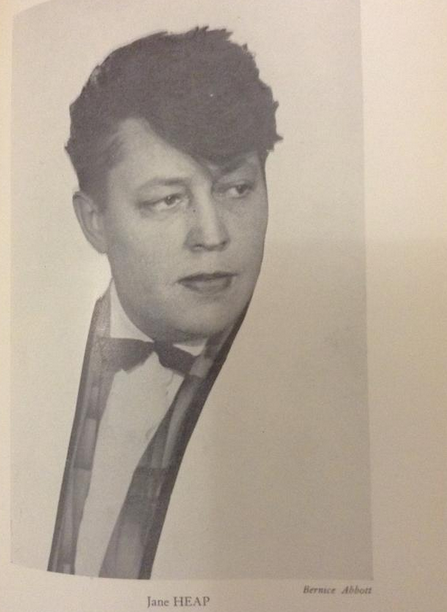
In 1916, Anderson met Jane Heap, and persuaded her to become the co-editor of Little Review. Heap’s brilliant intellect and excellent writing ability helped shape Little Review into the force it became, as it attracted all the new and exciting writing that was happening during the birth of modernism. 


Anderson and Heap fell in love, and if you want to see how in love just take Margaret’s gorgeous description of Jane in her memoir:


I felt in 1916 and feel to-day that Jane Heap is the world’s best talker.

It isn’t a question of words, facility, style. It isn’t a question of erudition. It isn’t even a question of truth. (Who knows whether what she says is true?) It is entirely a question of ideas. No one can find such interesting things to say on any subject. I have often I should my life over to talk-racing, with my money on Jane. No one else would ever win – you can win against magic.

Moving from the cabin in Lake Michigan to a ranch in Muir Woods and then Greenwich Village in New York, the pair published Little Review and, along with their London editor Ezra Pound, transformed it into the leading review of the time Hart Crane, Gertrude Stein, TS Eliot, Ford Madox Ford, Jean Cocteau, Hemingway – the list of authors and artists who contributed is pretty much a roll call of the most revolutionary and extraordinary people of the period. 

But it is perhaps for Ulysses that Little Review is most famous – and another example of how the women who helped bring Ulysses to print have been ignored by history (see Sylvia Beach). 

In 1918, Little Review began to serialise Ulysses, and they continued to serialise it until 1921 when the US Post Office seized copies of the magazine and refused to distribute it, citing its “obscene” content. 

Both Heap and Anderson were hauled up into the courts, charged with obscenity. They famously lost the case – having to pay a fine of $100 and Ulysses was banned in the US until 1934. During the trial, Heap defended their decision to publish Joyce’s most famous work. She said:

It was poet, the artist, who discovered love and created the lover, made sex everything that it is beyond a function. It is the Mr Sumners who have made it an obscenity.”

I love this quote. You can see what Anderson means, can’t you, about how Jane Heap talks? 

After the trial, the pair decamped to Paris (making them officially women of the Left Bank) and continued to publish Little Review there. Famously, they didn’t pay their contributors, proving that it’s not just today that writers have to work for free…

I’m tempted to say that our cultural forgetfulness of Anderson and Heap, without whom one of the most influential modernist publications would simply not have existed, is down to sexism. After all, the other great taste-makers of the age are remembered, although I am willing to concede that this could be contributed to the fact that they also produced their own novels and poetry (Anderson and Heap did too, although it’s not well circulated). I do think there is a whiff of sexism in particular about the forgetting of the three women who made such a difference to Joyce’s publishing history – especially as Joyce so spectacularly betrayed Sylvia Beach. 

There were a huge number of women publishing and distributing work in the modernist era, and most of their names are forgotten now. And yet, without women like Heap and Anderson, journals like Little Review would not have been the first publishers of some of the century’s most famous and revered writers and artists. We should celebrate these women; we should remember their names. They helped shape literary and cultural history. They were loved and respected by their peers and contemporaries. Let’s not allow them to be forgotten. 

Read the rest of the series